
The other day, one of my website and SEO clients forwarded me an email about Google’s new AI Overviews. She was wondering how Google AI Overviews are changing SEO.
A few minutes later, she texted me.
Not because her rankings had dropped. Not because her website had stopped working.
She had that sinking feeling many business owners have these days whenever Google or AI makes the news.
She summed it up in five words:
“Everything is changing again.”
We talked for a few minutes, and I explained what the email was actually saying. The update wasn’t nearly as dramatic as it sounded at first glance, and by the end of the conversation, she felt much better.
This wasn’t the first conversation I’d had about Google AI Overviews, and I’m sure it won’t be the last.
That conversation stuck with me.
Because I don’t think she was really worried about Google AI Overviews.
She was worried about what they represented.
For years, business owners have been told they need to keep up with Google’s algorithm updates, social media changes, AI tools, website best practices, and the latest marketing trends. Every new announcement seems to come with an unspoken message: Everything you were doing yesterday isn’t good enough anymore.
It’s exhausting.
The question isn’t whether Google AI Overviews are changing SEO.
They are.
The better question is this:
What should business owners actually do about it?
The good news is that while search is evolving, the fundamentals of building a website that earns trust, attracts the right visitors, and turns them into customers haven’t disappeared. In this article, we’ll look at what Google AI Overviews are, how they’re changing SEO, what actually matters for your business, and what you can safely ignore.
What Are Google AI Overviews?
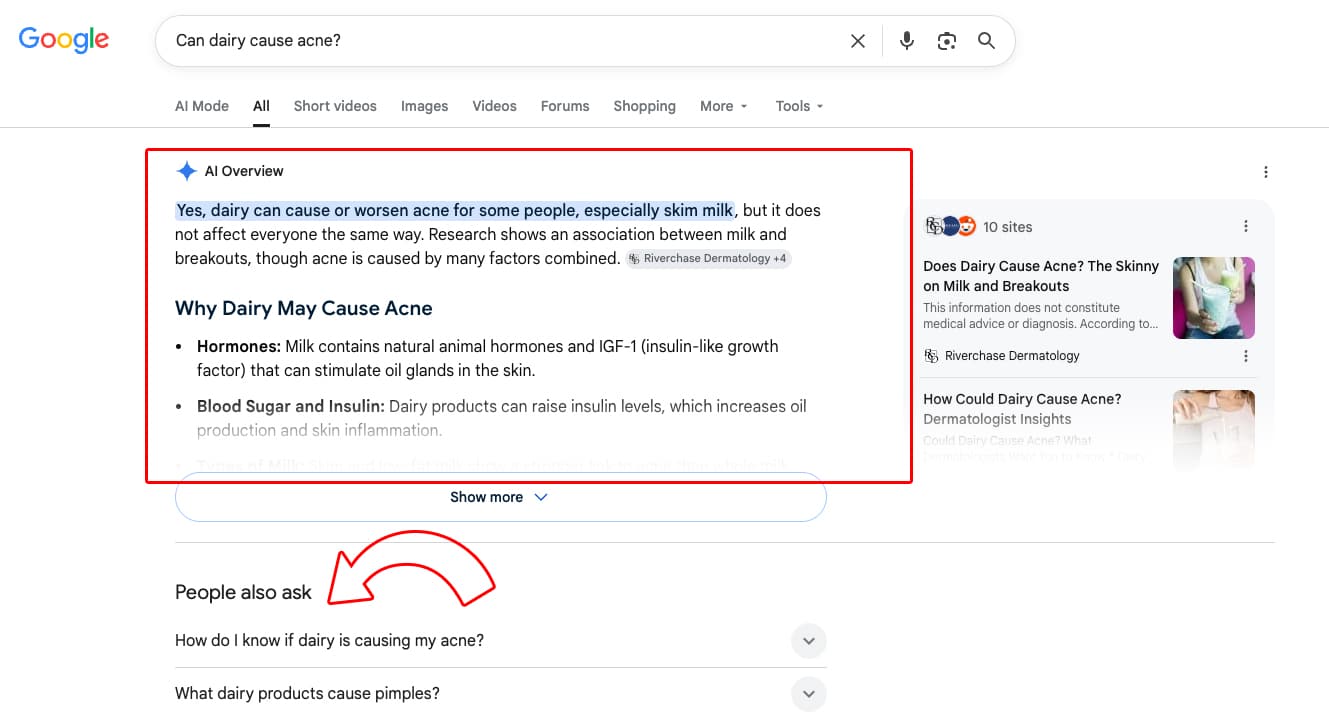
Google AI Overviews are AI-generated summaries that sometimes appear at the top of Google’s search results. Instead of showing only a list of websites, Google uses artificial intelligence to answer a user’s question by pulling together information from multiple sources across the web.
For example, if someone searches for “Can dairy cause acne?”, they may first see an AI-generated summary discussing the current research, possible contributing factors, and common recommendations before scrolling down to the traditional search results.
The information in an AI Overview isn’t written by a single website. Instead, Google’s AI analyzes information from a variety of trusted sources and creates a summary designed to answer the searcher’s question as quickly as possible.
You’ll often notice links included within the AI Overview. Those links point readers to the websites Google used to help generate its response, so people can read more if they want to.
Google doesn’t display AI Overviews for every search. They tend to appear most often when someone is looking for information, comparing options, or asking a question that doesn’t have one simple answer. Searches like “What vitamins help with hair loss?” or “Does collagen help your skin?” are good examples.
If someone searches for something highly specific, such as the name of a local business, today’s weather, or a particular website, they’re much less likely to see an AI Overview.
This has led many business owners to wonder whether people will stop clicking through to websites altogether.
It’s a reasonable question. The answer, however, is a little more nuanced than many of the headlines would have you believe.
How Google AI Overviews Are Changing SEO
Google AI Overviews aren’t changing the goal of SEO.
They’re changing how people interact with search results.
For years, the path was fairly straightforward. Someone typed a question into Google, skimmed the search results, clicked a website, and looked for an answer.
Now, Google often answers part of that question before the user ever clicks. That doesn’t mean websites don’t matter anymore.
Websites are still where people decide whether they trust you enough to become a client. They just have to earn the click in different ways.
Some searches may receive fewer clicks.
If someone searches “Can stress cause acne?”, Google may answer the question directly in an AI Overview, reducing the need to visit another website for a basic explanation.
That’s especially true for broad educational searches with relatively straightforward answers.
This phenomenon is often called a “zero-click search,” and it’s becoming more common as AI search evolves.
Authority matters more than ever.
Google’s AI doesn’t create information from thin air. It builds its responses using information it finds across trusted websites.
Every blog post, FAQ, guide, and service page gives Google another opportunity to understand your expertise and recognize your business as a trustworthy source.
In other words, demonstrating your expertise is no longer just about ranking. It’s about becoming a source Google trusts.
Well-organized websites are easier for AI to understand.
Your website shouldn’t make visitors work to understand what you do, who you help, or why you do it.
The same is true for Google’s AI.
Straightforward headings, logical organization, descriptive page titles, and well-written content make it easier for both people and search engines to understand your website.
Good SEO has always been about helping search engines understand your content. AI hasn’t changed that. If anything, it’s made it even more important.
Search behavior is changing.
People are also asking different kinds of questions.
Instead of searching for:
“Acne treatment menopause”
Someone might ask:
“What’s the best treatment for hormonal acne in women over 40?”
AI has encouraged people to search more conversationally. That’s creating opportunities for businesses that answer real client questions instead of stuffing pages with keywords.

Businesses still have an opportunity to be found
Whether you serve clients across the country or across town, Google AI Overviews haven’t eliminated your opportunity to be found.
Google still looks for businesses that demonstrate expertise, answer questions well, and have earned trust online. Your website, content, reviews, reputation, and Google Business Profile all help Google understand who you are and whether your business is a good fit for a particular search.
The difference is how someone finds you. Someone looking for “the best dietitian near me” may rely more heavily on local search signals, while someone searching for “how to reverse insulin resistance naturally” may discover your expertise through the content you’ve published.
In both cases, AI may answer the searcher’s first question.
But when they’re ready to decide who they trust, they’re still looking for a real business with real expertise and a compelling reason to choose one provider over another.
What Should You Do Differently?
If you’ve made it this far, you might be wondering whether it’s time to overhaul your website or completely rethink your SEO strategy.
Probably not.
Most businesses don’t need a brand-new strategy. They need to keep doing the fundamentals well while making a few adjustments along the way.
Here’s where I’d focus.
Continue answering common questions with your content.
Google’s AI has to get its information from somewhere. That somewhere may as well be you, right?
Every blog post, FAQ, guide, and service page is another chance to demonstrate that you know your subject.
Instead of trying to outsmart Google’s algorithm, focus on answering the questions your clients are already asking.
Strengthen your service pages.
Many websites spend so much time talking about the business that they forget to answer the visitor’s questions.
Within a few seconds of landing on one of your service pages, someone should understand:
- Who you help
- What problem you solve
- Why they should trust you
- What to do next
Those fundamentals have always mattered. AI hasn’t changed that.
Keep your Google Business Profile up to date.
Your Google Business Profile remains one of the strongest trust signals you can send, especially if you work with clients in a specific geographic area.
Make sure your services are accurate, your hours are current, your photos are recent, and you’re consistently collecting reviews from happy clients.
Even businesses that work primarily online can benefit from maintaining a complete, professional profile.
Don’t chase every headline.
This is one of the most common mistakes I see business owners make.
Every few months, there will be another article announcing that SEO is dead, Google changed everything, or AI has completely rewritten the rules.
Most of those headlines are designed to get clicks, not to give you practical advice.
The businesses that succeed over the long term aren’t the ones that panic every time Google releases an update. They’re the ones that consistently publish answers to real client concerns, maintain a trustworthy website, and make steady improvements over time.
Those businesses tend to weather Google’s changes far better than the ones constantly starting over.
Four Questions Every Service Page Should Answer
When I review websites, I often find that the problem isn’t poor design or bad SEO.
It’s that the website never clearly answers the questions potential clients are already asking.
- Who do you help?
- What do you actually do?
- Why should anyone trust you?
- And what should they do next?
If AI is changing how people search, what should your website do differently?
Surprisingly little.
Whether someone finds you through a traditional Google search, a Google AI Overview, ChatGPT, Alexa, your Google Business Profile, or a referral from a friend, your service pages still have one job: help the right person feel confident that they’ve found the right business.
Every service page on your website should answer these four questions.
1. Is this for someone like me?
Visitors should immediately know who you help and whether they’re in the right place.
Don’t make them guess.
If you specialize in helping women over 40 with hormonal acne, say that. If you work with busy professionals managing prediabetes, say that. If your practice is virtual, local, or serves a particular niche, make it glaringly obvious.
The faster visitors recognize themselves in your content, the more likely they are to keep reading (and book with you).
2. How can you help me?
This is where you explain your service in plain English.
Instead of listing features or credentials, focus on the problems you solve and the outcomes your clients are looking for.
Help visitors understand what working with you looks like, what they can expect, and why your approach may be a good fit for their situation.
3. Why should I trust you?
Anyone can claim they’re an expert. This is where you back it up.
Include reviews, testimonials, certifications, years of experience, before-and-after photos (when appropriate), media features, professional memberships, or real client success stories.
Trust is earned through proof.
4. What should I do next?
After reading your page, visitors shouldn’t have to wonder what comes next.
Whether you want them to schedule a consultation, book an appointment, complete a contact form, or call your office, make the next step obvious and easy.
A confused visitor rarely becomes a client.
When you step back, you’ll notice something interesting about these four questions.
None of them were invented because of AI.
They’ve always been the foundation of a website that converts visitors into clients. Google AI Overviews haven’t changed that. If anything, they’ve made it even more important to communicate clearly and build trust from the second someone lands on your website.
Not sure how your own service pages measure up?
During a complimentary strategy call, we’ll review your website together, identify what’s already working, point out opportunities for improvement, and help you separate the changes that matter from the ones you can safely ignore.

When Should You Change Your SEO Strategy?
Google AI Overviews have certainly changed parts of SEO. But that doesn’t mean every business needs to throw out its marketing plan and start over.
In most cases, the answer isn’t to build a new website, rewrite every page, or abandon the strategy that’s been working for you.
Instead, ask yourself a few questions.
Has your business changed? Maybe you’ve introduced new services, narrowed your niche, or shifted from seeing clients locally to working virtually. If your business has evolved, your website should reflect that.
Are your clients searching differently? As search behavior becomes more conversational, you may find opportunities to create content that answers the questions people are actually asking today.
Are your service pages still doing their job? If they no longer clearly explain who you help, how you help them, and why someone should choose you, they’re worth revisiting.
Have your traffic, inquiries, or bookings declined? Headlines can make it feel like everything is changing overnight, but your own data tells a much more accurate story. Before making major changes, look at what’s happening on your website, not what’s trending in the news.
If the answer to those questions is “no,” you probably don’t need a new SEO strategy. You just need to keep improving the one you already have.
Continue answering your clients’ questions. Keep your website up to date. Strengthen the pages that matter most. Build trust with every opportunity you have.
Small, consistent improvements almost always outperform dramatic overhauls driven by the latest headline.
The Real Lesson From Google AI Overviews
So, how are Google AI Overviews changing SEO?
They’re changing how people discover information. They’re changing how Google presents answers. They’re changing which websites earn the click. But they haven’t changed what makes a business worth trusting.
Looking back, I don’t think my client was really asking about Google AI Overviews. She was asking whether everything she’d worked so hard to build had stopped mattering.
The answer was no. Google had changed. Her business hadn’t. Her expertise hadn’t. Her reputation hadn’t. Her relationships with her clients hadn’t. Her clients still need her. And her website still has an important job to do.
It still needs to help people understand who she helps, what she offers, and why they should trust her. It still needs to answer questions, showcase her expertise, and make it easy for someone to take the next step.
Would we continue to make improvements over time? Of course.
That’s true whether Google introduces AI Overviews, releases another algorithm update, or changes the search results in some other way.
Good websites have never been “finished.”
They evolve alongside the businesses they represent. That’s very different from starting over.
If there’s one lesson to take away from Google AI Overviews, it’s this:
Don’t mistake change for a reason to panic.
Most businesses don’t need to rebuild everything they’ve created. They just need to continue building on a solid foundation.

Wondering What Google AI Overviews Mean for Your Website?
Every business is different.
A Google update that has a big impact on one business may have very little effect on another. That’s why trying to make decisions based on headlines alone can lead to unnecessary work (and unnecessary stress).
Instead of guessing what Google’s latest update means for your website, let’s look at what’s really happening behind the scenes.
When you schedule a complimentary strategy call, you’ll also receive a free SEO audit of your website.
Together, we’ll review your current SEO performance, identify what’s working, look at opportunities to improve your visibility, and prioritize the changes most likely to move the needle for your business.
Just as importantly, we’ll help you avoid wasting time fixing things that aren’t broken.
Whether Google AI Overviews have affected your website or you’re simply wondering if they have, you’ll leave the call with a better understanding of where you stand and practical next steps based on your business, not the latest headline.
Schedule your complimentary strategy call and free SEO audit today.